
CIOReview APAC Weekly Brief
Be first to read the latest tech news, Industry Leader's Insights, and CIO interviews of medium and large enterprises exclusively from CIOReview APAC
This article is part of CIOReview's Innovation Insights series featuring expert contributions nominated by our subscribers and reviewed by our editorial team.

OneAsia Empowering Business Excellence at Cloud and Edge
While the Covid-19 pandemic fundamentally changed the way businesses operate and connect with their customers, a cloud-based or hybrid workplace and a more reliable data infrastructure have become an agenda for enterprises of all sizes. In order to implement such digital transformation more flexibly and cost-effectively, it is common for businesses to adopt Platform as a Service (PaaS), Software as a Service (SaaS), and other turnkey solutions.
In some hybrid environments, cloud applications are extended to the edge to achieve faster computing, better availability, and lower costs. As a part of cloud infrastructure, edge is closer to data sources thus improving the efficiency of data-intensive workload. Meanwhile, for next-generation applications, computing at both cloud and edge allows better scalability, especially in science and research industries.
Through OAsis, OneAsia will advance the end-user adoption of high-performance computing infrastructure and drive enterprises' supercomputing capability to achieve innovation excellence.
What Can OneAsia Offer: High-Performance Computing
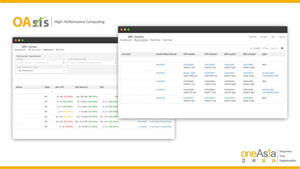
A recent breakthrough of OneAsia is its high-performance computing solution OAsis, a hybrid computing platform with unparalleled flexibility and performance to support modern businesses of all sizes. With the launch of OAsis portal, OneAsia becomes the 1st colocation service provider in Hong Kong to offer high-performance computing solution.
OAsis and OneAsia’s other cloud solutions bundle with hardware, data storage, and network connectivity, offer a better high-performance computing choice for scientists, researchers, start-ups, and SMEs. Via the user-friendly and intuitive OAsis portal, users can have more time focusing on their modelling and simulation runs, while enjoying the flexibility to scale up and down capacity and reducing costs via consumption-based pricing and billing.
Through OAsis, OneAsia will advance the end-user adoption of high-performance computing infrastructure and drive enterprises' supercomputing capability to achieve innovation excellence. OAsis will also help business entities enhance agile computing adoption and facilitate better resource allocation to reduce costs.
What Can OneAsia Offer: Immersion Cooling
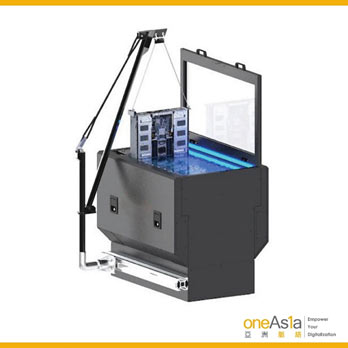
Along with the growing demand for computing power, the rack density at data centre is also increasing. In view of this, OneAsia has recently launched an immersion cooling solution, the first of its kind in Hong Kong. The solution brings significant advantages over traditional air-cooling techniques, especially for high-capacity data centres.
For facilities with extremely high-density racks (typically over 30 kW), where air cooling simply is not sufficient to maintain the reliability of IT systems, liquid cooling is not a choice, but a necessity. This solution also reduces server energy use significantly as no water consumption and no fan energy are used, resulting in a 45% lower carbon footprint than that of air-cooled data centres, and a PUE of 1.09 or lower. In terms of cost efficiency, liquid cooling maximizes data centre space and decreases
MORE FROM INNOVATION INSIGHTS

Customer-Centric Quality Assurance: The Missing Link in Digital Transformation


Why Global Infrastructure Requires a Shift from Local Systems to Connected, Scalable Platforms
EXPLORE OUR KNOWLEDGE NETWORK
The articles from these contributors are based on their personal expertise and viewpoints, and do not necessarily reflect the opinions of their employers or affiliated organizations.
