

TEN
Breaking the Barriers to Entry for AI Implementations with AI Pub, TEN's MLOps solution

 Sejin Oh, CEO
There are three fundamental prerequisites for ensuring successful AI implementation in businesses: a skilled workforce specializing in AI development, high-quality data for training the algorithms, and a robust infrastructure to support both training and deployment of AI systems.
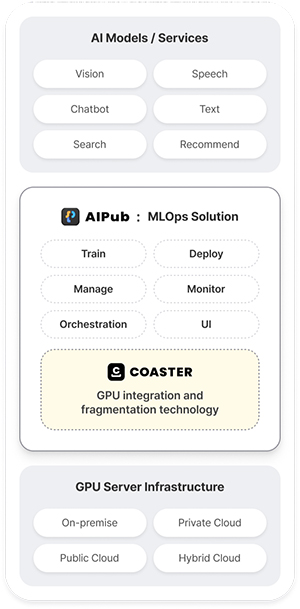
TEN’s distinctiveness lies in tackling the complexities tethered to AI infrastructure.
Two core challenges TEN adeptly addresses are resource allocation and innovative GPU utilization. It’s not just about having top-tier data scientists and hardware; it’s also about ensuring these resources are used effectively. Inefficient resource management can lead to bottlenecks, higher operational costs, and underutilized GPU capacity.
In the South Korean market, where businesses across various sectors, such as finance, healthcare, manufacturing, and technology, are keen to harness AI’s potential, TEN’s robust MLOps solutions make the process less daunting.
Central to TEN’s proposition is its container platform, COASTER, which underpins the AI Pub Dev and AI Pub Ops solutions. The AI Pub Dev ensures AI training runs efficiently, while AI Pub Ops enables AI services to run with significant cost savings and increased utilization. These solutions holistically address the triad of AI infrastructure: compute nodes, network fabric, and storage, ensuring a seamless operational flow.
At the heart of the AI infrastructure lie the compute nodes. Think of it as a vast, interconnected web of computing resources. Within this node, InfiniBand, a network communication protocol, is a key component for high-performance computing (HPC) and AI infrastructure. However, TEN chooses between IB and ethernet depending on the specific demands of the customer’s workload.
There’s a catch in this process. Setting these up and ensuring proper permission management requires a deep understanding of its mechanics, which requires specialized infrastructural engineers.
This is where AI Pub Dev steps in. It automates and streamlines permissions across four crucial resources: server nodes, namespaces, image registries, and shared storage. It determines who can use which resources and to what extent without manual hiccups. By meticulously overseeing this, AI Pub Dev ensures AI training runs efficiently.
But instead of defaulting to the conventional Kubernetes scheduler, AI Pub Dev employs a specialized scheduler crafted in-house. It is highly adaptable. Organizations can tailor it to align with their unique policies and specifications, enabling them to optimize the resource allocation process according to their specific needs.
The other aspect is rethinking GPU utilization. Traditionally, resource allocation for AI tasks has been rigid. One GPU was designated for a single AI task or container, irrespective of the actual computational demand. The reality is that many AI services don’t require the full power of a GPU. Assigning a complete GPU for minor tasks is cost-effective when the demand is low. However, during peak times, it’s like using a sledgehammer to crack a nut, leading to unnecessary expenses.
This is where AI Pub Ops steps in. Instead of rigidly allocating entire GPUs, AI Pub Ops fragments a GPU into 100 units. Think of it as slicing a pie; each slice is potent enough for most AI tasks. By doing so, AI services can run efficiently, using only a fraction of the GPU they need. This method results in significant cost savings and increased utilization, making the AI infrastructure responsive to varying demands.
“Clients have successfully transitioned from running services on ten machines to just one, all while maintaining a stable operational environment with AI Pub Ops. It allows them to focus on developing applications and services while we expertly manage the intricate infrastructure setup,” says Sejin, CEO of TEN.
A testament to its exceptional impact can be found in TEN’s collaboration with a customer in the public sector. AI Pub has been instrumental in helping the client manage one of the largest AI infrastructure clusters in South Korea, potentially ranked in the world’s top 100. This partnership allows them to efficiently run and share the cluster among multiple users for AI model development.
But that’s not all; TEN serves a wide range of clients across various industries. For example, LG Electronics uses TEN’s products to manage factories and detect issues, while KB Card, a credit card company, employs its solution for text-to-speech systems in call centers to enhance customer service.
Since its inception in 2020 with a small team, TEN has experienced rapid growth and gained recognition, becoming a game changer in the industry. In 2021, it received the prestigious honor of being selected to participate in the Top Startups session at NVIDIA GTC, representing South Korea.
TEN’s pioneering efforts in AI infrastructure offer South Korean businesses a clear path to unlocking the transformative power of AI, with a focus on cost-efficiency and adaptability. From automating resource allocation to innovative GPU utilization, TEN’s expertise ensures AI will no longer remain a buzzword but a practical and accessible tool for organizations of all sizes.
At the heart of the AI infrastructure lie the compute nodes. Think of it as a vast, interconnected web of computing resources. Within this node, InfiniBand, a network communication protocol, is a key component for high-performance computing (HPC) and AI infrastructure. However, TEN chooses between IB and ethernet depending on the specific demands of the customer’s workload.
There’s a catch in this process. Setting these up and ensuring proper permission management requires a deep understanding of its mechanics, which requires specialized infrastructural engineers.
This is where AI Pub Dev steps in. It automates and streamlines permissions across four crucial resources: server nodes, namespaces, image registries, and shared storage. It determines who can use which resources and to what extent without manual hiccups. By meticulously overseeing this, AI Pub Dev ensures AI training runs efficiently.
But instead of defaulting to the conventional Kubernetes scheduler, AI Pub Dev employs a specialized scheduler crafted in-house. It is highly adaptable. Organizations can tailor it to align with their unique policies and specifications, enabling them to optimize the resource allocation process according to their specific needs.
The other aspect is rethinking GPU utilization. Traditionally, resource allocation for AI tasks has been rigid. One GPU was designated for a single AI task or container, irrespective of the actual computational demand. The reality is that many AI services don’t require the full power of a GPU. Assigning a complete GPU for minor tasks is cost-effective when the demand is low. However, during peak times, it’s like using a sledgehammer to crack a nut, leading to unnecessary expenses.
Our AI Pub Dev ensures AI training runs efficiently, while AI Pub Ops enables AI services to run with significant cost savings and increased utilization
“Clients have successfully transitioned from running services on ten machines to just one, all while maintaining a stable operational environment with AI Pub Ops. It allows them to focus on developing applications and services while we expertly manage the intricate infrastructure setup,” says Sejin, CEO of TEN.
A testament to its exceptional impact can be found in TEN’s collaboration with a customer in the public sector. AI Pub has been instrumental in helping the client manage one of the largest AI infrastructure clusters in South Korea, potentially ranked in the world’s top 100. This partnership allows them to efficiently run and share the cluster among multiple users for AI model development.
But that’s not all; TEN serves a wide range of clients across various industries. For example, LG Electronics uses TEN’s products to manage factories and detect issues, while KB Card, a credit card company, employs its solution for text-to-speech systems in call centers to enhance customer service.
Since its inception in 2020 with a small team, TEN has experienced rapid growth and gained recognition, becoming a game changer in the industry. In 2021, it received the prestigious honor of being selected to participate in the Top Startups session at NVIDIA GTC, representing South Korea.
TEN’s pioneering efforts in AI infrastructure offer South Korean businesses a clear path to unlocking the transformative power of AI, with a focus on cost-efficiency and adaptability. From automating resource allocation to innovative GPU utilization, TEN’s expertise ensures AI will no longer remain a buzzword but a practical and accessible tool for organizations of all sizes.
| Share this Article: Tweet
|
Company
TEN
Management
Sejin Oh, CEO
Description
TEN is a software development company with an ambitious mission to democratize the field of artificial intelligence for all. TEN’s distinctiveness lies in tackling the complexities tethered to AI infrastructure with MLOps solution.

