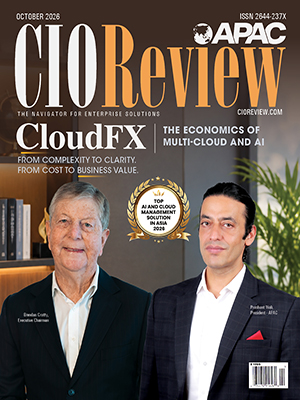
CloudFX
The Economics of Multi-Cloud and AI from Complexity to Clarity. From Cost to Business Value.

 Brendan Crotty, Executive Chairman and Prashant Wali, President - APAC
AI has Changed
The Economics of Technology.
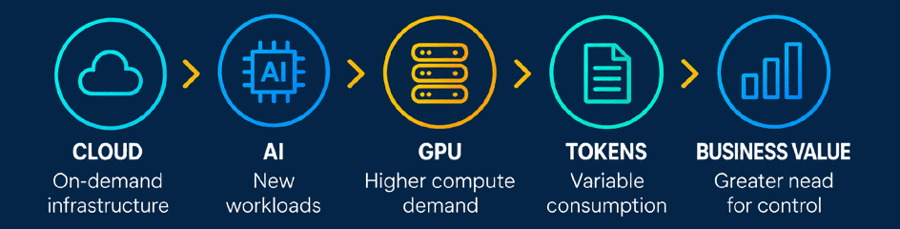
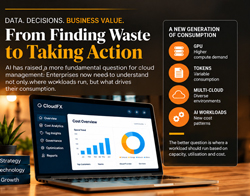
Traditional cloud economics could be measured through CPU usage and virtual machines. AI brings GPUs, tokens and new consumption patterns into the mix, changing how enterprises need to think about technology spend, governance and control.
3 Months Annual cloud budget consumed
One CloudFX customer consumed its annual cloud budget within three months. The organization was spending at roughly four times the rate it had planned, highlighting how quickly AI-era workloads can alter technology consumption patterns.
When Cloud Consumption Outruns the Budget
The problem is not theoretical. One CloudFX customer approached the company after using its entire annual cloud service provider budget within three months. CloudFX says it has also encountered cloud service provider charges five to seven times higher than the previous year. AI has added another layer of uncertainty, particularly where GPU and token-based consumption is involved.
A Management Platform Built for Complexity
CloudFX began building cloud management platforms around 2014 and is now in about its seventh generation. Its early platforms required substantial infrastructure and were largely suited to very large organizations. Over roughly three years, the company redesigned the architecture around lighter platforms with lower infrastructure requirements and reduced user charges. The reason for that evolution was straightforward. Cloud environments were changing and the platform had to change with them. Today, enterprises rarely operate in a single cloud environment. CloudFX integrates directly with AWS, Azure, GCP, VMware and Oracle and can measure usage across geographic regions, divisions and business units.
Same Complexity. A Clearer Way Forward.
A common view helps organisations connect technology consumption with cost, operational activity and business priorities — making it easier to see where resources are being used, where costs are changing and where action is required.
Techsaverfx and Cloud Financial Management
TechSaverFX, CloudFX's FinOps product, identifies where costs are generated, measures the usage associated with those resources and highlights underutilized capacity. A server might be paid for but barely used while another resource carries a workload that could be shifted elsewhere.
TechSaverFX can identify those conditions and recommend actions such as changing load distribution or taking unused resources offline. The platform also includes an automation mechanism that can enforce recommendations through the same platform, creating a cycle from identifying a potential saving to taking corrective action.
 CloudFX also considers private cloud infrastructure and data centers as part of the same financial equation. Enterprises have already invested in those assets, so moving workloads to public cloud simply because it is available does not necessarily make economic sense.
AI Changes What Cloud Visibility Means
CloudFX began experimenting with AI about 18 months ago to understand the technology from first principles. That work led to a focus on the metrics behind AI-related cloud charges. Prashant Wali, President - APAC at CloudFX, says enterprises need to put guardrails around AI spending before budget overruns occur rather than reacting after the money has already been spent.
The issue becomes particularly difficult when token consumption starts behaving differently from the economics enterprises were accustomed to in conventional cloud environments. CloudFX has therefore specialized in GPU and token economics metrics, with Crotty describing the capture of AI usage metrics as one of the company's most important areas of work.
CloudFX is not simply helping customers calculate what AI costs. It is extending the measurement discipline that emerged around cloud and FinOps into a new generation of AI workloads.
Cloudselectfx: One Management Layer
CloudSelectFX applies its management layer across hybrid IT. The platform is designed for environments where applications and workloads can sit across public and private cloud resources. It provides self-service, lifecycle management, unified governance, and control, as well as hybrid and multi-cloud management through automation and operational analytics.
Its architecture is deliberately open, modular and integrated, allowing cloud resources to be managed through a single management layer rather than forcing IT teams to navigate each environment independently.
From Cost, Control and Operations to Business Value
Cloud management has developed into several disciplines that often operate separately. FinOps teams look at cost. CloudOps teams manage infrastructure. AIOps teams monitor systems and use AI-related technologies.
Converged Operations for a Broader Impact
CloudFX's answer is what Wali describes as converged operations. SinglePaneFX sits across FinOps, CloudOps and AIOps to provide business-aware analytics and decision support for leadership teams such as CIOs, CTOs and CDOs.
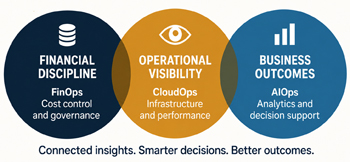 The idea is less about putting more dashboards in front of executives and more about connecting the information already being generated across the environment. Cost, investment, budget, performance, utilization, compliance and automation data can provide a clearer basis for technology decisions when viewed together.
That becomes especially relevant as AI moves from experimentation into enterprise adoption. CIOs are under pressure to adopt the technology, but adoption alone does not establish a business case. Leaders still need to understand what they are spending, what resources are being consumed and whether the investment is producing the intended value.
Designed around the Way Customers Actually Operate
CloudFX's experience has also taught it that no two enterprise environments are identical. Its customers include OEMs, global system integrators, telecommunications companies and enterprises with different technology stacks and operating models.
The Broader Opportunity
CloudFX is continuing to invest in software development as it looks toward its next phase of growth. Its evolution from cloud management platforms to a more integrated architecture reflects a market where infrastructure, financial management and AI are increasingly difficult to treat as separate concerns.
That gives context to its recognition as the Top AI and Cloud Management Solution in Asia 2026. The distinction is ultimately about control. Enterprises have more choices in where they run workloads, but those choices create more complexity in managing cost, capacity, governance and performance.
CloudFX is building around the idea that those decisions work better when the underlying data, management tools and automation sit within the same broader framework.
See. Understand. Act.

That creates a practical requirement for customization.
Crotty says customization can range from about 15 percent of the total fee to as much as 40 percent, particularly when the platform needs to integrate with legacy systems and application software. He describes the ability to handle complexity while simplifying the customer experience as one of CloudFX's competitive advantages.
Customer input has also shaped the product roadmap. Major clients provide guidance on where the market is heading, giving CloudFX insight into requirements several months ahead and influencing development over the past four or five years.
Implementation and Measurable Impact
Wali describes the software as a lightweight, low-code application deployed within the customer's environment. Once deployed, it can automatically discover cloud environments, map resources and begin analyzing utilization and operational data. The system establishes an initial baseline before its models begin generating recommendations.
Over time, those recommendations become more advanced, covering cost, performance, scalability, control, governance, compliance and automation. CloudFX typically charges about one to two percent of the cloud technology costs being managed. Crotty says customers generally see initial savings of about 20 to 30 percent. These figures are company-reported rather than independently verified benchmarks.
CloudSelectFX applies its management layer across hybrid IT. The platform is designed for environments where applications and workloads can sit across public and private cloud resources. It provides self-service, lifecycle management, unified governance, and control, as well as hybrid and multi-cloud management through automation and operational analytics.
-
If you can't measure it, you can't manage it.
Its architecture is deliberately open, modular and integrated, allowing cloud resources to be managed through a single management layer rather than forcing IT teams to navigate each environment independently.
From Cost, Control and Operations to Business Value
Cloud management has developed into several disciplines that often operate separately. FinOps teams look at cost. CloudOps teams manage infrastructure. AIOps teams monitor systems and use AI-related technologies.
Converged Operations for a Broader Impact
CloudFX's answer is what Wali describes as converged operations. SinglePaneFX sits across FinOps, CloudOps and AIOps to provide business-aware analytics and decision support for leadership teams such as CIOs, CTOs and CDOs.
The idea is less about putting more dashboards in front of executives and more about connecting the information already being generated across the environment. Cost, investment, budget, performance, utilization, compliance and automation data can provide a clearer basis for technology decisions when viewed together.That becomes especially relevant as AI moves from experimentation into enterprise adoption. CIOs are under pressure to adopt the technology, but adoption alone does not establish a business case. Leaders still need to understand what they are spending, what resources are being consumed and whether the investment is producing the intended value.
Designed around the Way Customers Actually Operate
CloudFX's experience has also taught it that no two enterprise environments are identical. Its customers include OEMs, global system integrators, telecommunications companies and enterprises with different technology stacks and operating models.
The Broader Opportunity
CloudFX is continuing to invest in software development as it looks toward its next phase of growth. Its evolution from cloud management platforms to a more integrated architecture reflects a market where infrastructure, financial management and AI are increasingly difficult to treat as separate concerns.
That gives context to its recognition as the Top AI and Cloud Management Solution in Asia 2026. The distinction is ultimately about control. Enterprises have more choices in where they run workloads, but those choices create more complexity in managing cost, capacity, governance and performance.
CloudFX is building around the idea that those decisions work better when the underlying data, management tools and automation sit within the same broader framework.
See. Understand. Act.
That creates a practical requirement for customization.
Crotty says customization can range from about 15 percent of the total fee to as much as 40 percent, particularly when the platform needs to integrate with legacy systems and application software. He describes the ability to handle complexity while simplifying the customer experience as one of CloudFX's competitive advantages.
Customer input has also shaped the product roadmap. Major clients provide guidance on where the market is heading, giving CloudFX insight into requirements several months ahead and influencing development over the past four or five years.
Implementation and Measurable Impact
Wali describes the software as a lightweight, low-code application deployed within the customer's environment. Once deployed, it can automatically discover cloud environments, map resources and begin analyzing utilization and operational data. The system establishes an initial baseline before its models begin generating recommendations.
Over time, those recommendations become more advanced, covering cost, performance, scalability, control, governance, compliance and automation. CloudFX typically charges about one to two percent of the cloud technology costs being managed. Crotty says customers generally see initial savings of about 20 to 30 percent. These figures are company-reported rather than independently verified benchmarks.
AI and Cloud Management at the Point of Financial Control
Enterprise cloud strategy has moved from migration planning to daily financial control. AI has accelerated that shift. Workloads that once depended mainly on predictable CPU consumption now draw on GPU capacity, token-based usage and data-intensive services that can expand faster than annual budgets anticipate. For executives responsible for cloud management investment, the question is no longer whether cloud platforms can support scale. It is whether the enterprise can see, govern and adjust consumption before cost growth becomes a board-level issue.
This pressure is sharpened by multi-cloud adoption. Large organizations often use AWS, Azure, Google Cloud, Oracle, private cloud assets and virtualized infrastructure in parallel. Each environment may offer its own reporting console, pricing model and governance logic. That fragmentation makes it difficult for IT, finance and business leaders to agree on what is being used, which units are driving consumption and where paid capacity is idle or underused. Cloud management software now has to translate technical activity into accountable business information.
The strongest solutions give leaders a unified view of services, usage, performance dependency and cost attribution. Visibility must reach beyond invoices and dashboards. It should expose the relationship between workloads, capacity, geography, business unit and actual utilization so that decisions are based on measurable consumption rather than assumptions. AI increases the importance of this discipline because GPU and token economics can distort prior cost models, making yesterday’s forecasting habits unreliable.
Financial control also needs to protect business speed. Cost reduction alone is not enough if it slows provisioning, weakens application performance or forces teams into manual approval cycles that frustrate delivery. Effective platforms help identify idle resources, rightsizing opportunities, workload placement options and abnormal usage patterns while keeping the business able to scale when demand is justified. This is where FinOps moves from reporting practice to management discipline, connecting finance, IT and business owners around shared accountability.
The buying decision also has a tools-rationalization dimension. Many enterprises have accumulated point products for monitoring, service requests, cost tracking, security alerts and governance. Each may solve a narrow problem, but the combined environment can increase reconciliation work. Executive buyers should favor software that reduces management friction rather than adding another console to be managed.
Interoperability is equally important. Enterprises cannot afford management software that deepens dependence on one provider or leaves teams reconciling data across disconnected tools. A strong AI and cloud management solution should support hybrid and multi-cloud environments, normalize information across providers and maintain consistent governance for distributed teams. The best fit for executive buyers is a platform that combines cost analytics, automation, lifecycle management, performance insight and policy control without forcing the organization into a rigid architecture.
Cloud FX emerges as the premier choice for organizations that need AI-aware cloud management tied directly to cost accountability. Its SinglePaneFX platform supports multi-cloud visibility, analytics and governance, while TechSaverFX focuses on FinOps, usage metrics and optimization across hybrid environments. The company’s transcript-backed strength lies in identifying unused or underused servers, shifting workloads to better-used capacity and measuring GPU and token-based economics that now shape AI cloud charges. Its vendor-agnostic integration with AWS, Azure, GCP, VMware and Oracle makes it especially relevant for enterprises managing complex estates rather than a single-provider environment.
...Read more
| Share this Article: Tweet
|
Company
CloudFX
Management
Brendan Crotty, Executive Chairman and Prashant Wali, President - APAC
Description
Cloud FX provides AI and cloud management solutions that help enterprises measure technology consumption, manage costs and improve resource utilization across complex multi-cloud environments. Its platform brings FinOps, CloudOps and AIOps into a unified decision-making framework.